

The Levels of Homophobia: Where Does Rejection Come From?
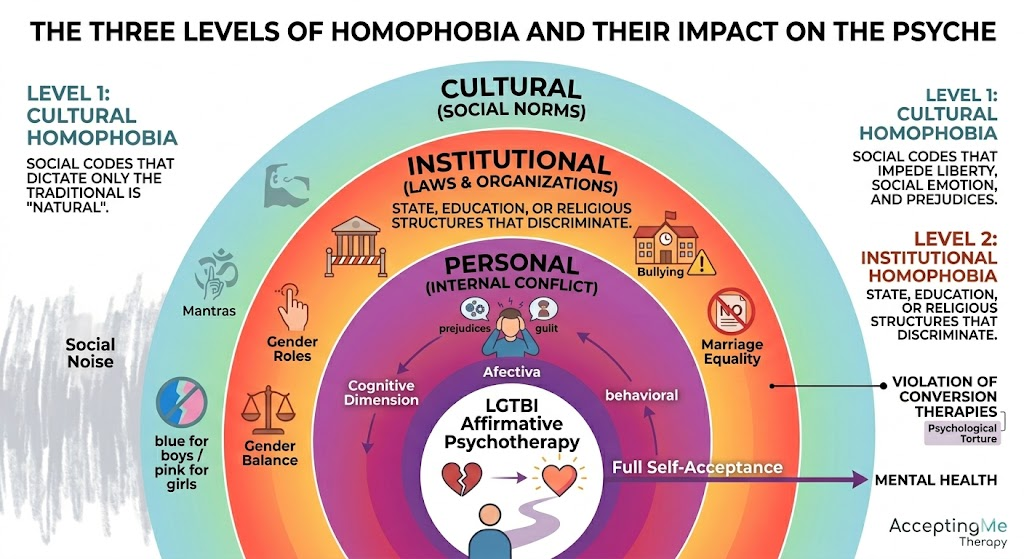
To understand this point, it is important to know that rejection doesn’t always come directly from one’s family or immediate circle. It stems from systemic levels that generate introjects—the unconscious incorporation of environmental norms, beliefs, or values that we make our own without questioning or “digesting” them.
Cultural Homophobia: The Social Noise
These are the codes that dictate that only the traditional is “natural.” It is an environment that tolerates you being “different,” as long as it isn’t too noticeable. It is the discourse of those who allow themselves to decide if you deserve acceptance—until they see public displays of affection. At that point, tolerance ends, and the “be gay, but keep it at home” mentality returns.
It is as simple as assigning blue for boys and pink for girls, or old mantras like “crying is for girls.” This carries a double negative message: crying is bad, and being a girl (the ones who cry) is also bad. Often, it is in these subtleties that the message sinks deepest.
Institutional Homophobia: External Barriers
This occurs when institutions, laws, or the media render our reality invisible. A clear example is the difficulty of accessing equal marriage or motherhood for same-sex couples in certain countries. A more subtle example is the “standard family” portrayed in advertising: heterosexual, normative, and often white.
Within this level, we find one of the most serious violations of human rights: conversion or reparative therapies. These are pseudoscientific interventions that claim to “change” or “suppress” a person’s sexual orientation or gender identity. Far from being therapies, they are processes of psychological torture based on guilt and shame. Their effects are devastating: they cause a total breakdown of self-esteem, chronic anxiety, Post-Traumatic Stress Disorder (PTSD), and feelings of hopelessness that nullify the individual’s personality.
Personal Homophobia: Internal Conflict
This happens when we end up believing that prejudices are true, feeling guilt, or rejecting our own “effeminacy” or “masculinity” (the “pluma”) to avoid ridicule.
A Mental Health Emergency: Suicide Rates in Europe
Oppression is not just a word; it has lethal consequences. According to various public health reports in Europe, the LGBTQ+ population presents rates of suicidal ideation and attempts 3 to 5 times higher than the heterosexual and cisgender population.
You can find more data in this article published by The Guardian with 2025 figures for the UK.
In the case of trans youth, the figures are even more alarming, with the risk often tripling due to family and social rejection. These data do not reflect an inherent fragility within the community, but rather the direct result of structural violence, isolation, and a lack of safe spaces.
An Even Harder Path for Trans, Queer, and Intersex People
For trans, queer, and intersex individuals, finding understanding is even more complex. Our society is built on a rigid binary system (male/female). Inhabiting a space outside of this scheme often results in a total lack of role models. These individuals frequently face immense loneliness and a lack of specialized training in the medical environment, which is why it is essential to approach therapy from an affirmative lens.
Stages Toward Self-Acceptance
No one is born hating themselves. Therefore, the path to full mental health involves navigating these stages:
- Feeling of Difference: That early sensation of not fitting in.
- Denial: Attempting to block what we feel to meet external expectations.
- Internal Struggle: Beginning to question the prejudices that have been “injected” into us.
- Integration and Consolidation: When you stop living a double life and your identity becomes just one more natural characteristic of who you are.
How Affirmative Therapy helps
The goal of therapy is not just to “endure” who you are, but to dismantle every absorbed prejudice. It is not about “tolerating” yourself; it is about reaching the point where, if there were a button to change who you are, you would choose not to press it because you are proud of your identity.
The mental health of the community is not affected by their orientation or identity itself, but by the response of a society that still prefers closets. Recognizing these patterns is the first step toward living an authentic life.
Your Space at AcceptingMe Therapy
If you feel that the weight of your identity or past experiences is still preventing you from living fully, AcceptingMe Therapy is here to accompany you. We are a specialized Affirmative Therapy service where you will find a safe and confidential space.
We work from empathy and personal experience, helping you heal the wounds of stigma and reclaim your power.
We invite you to take the step: book an initial 20-minute consultation. It is time to start loving yourself for everything you are.